



Bourbon ice cream sounds simple until you follow one barrel through the process Graeter's actually uses to make it. For Bourbon Ball, Graeter's own limited-edition bourbon ice cream, that process starts across the Ohio River at New Riff Distilling and doesn't end until the whiskey has traveled roughly 100 miles round trip, just to be legal to scoop in Cincinnati.
What makes Graeter's bourbon ice cream different
Graeter's Bourbon Ball ice cream is built on a partnership with New Riff Distilling, a Newport, Kentucky distillery founded in 2014. Graeter's and New Riff taste and select an entire barrel of bourbon together, rather than buying whiskey off a shelf. That barrel becomes the backbone of a flavor packed with real bourbon, whiskey-glazed pecans, and dark chocolate chunks.
The finished ice cream comes in under 0.5% alcohol by volume, the legal line for a nonalcoholic product. It still carries real bourbon character: spiced caramel up front, a hint of oak on the finish, and vanilla and pecan notes that show up fast on the palate.
Why the bourbon has to travel before it becomes ice cream
Graeter's and New Riff sit only eight miles apart, but they're on opposite sides of the Ohio River, in two different states with two different liquor systems. Ohio's liquor control regulations require the selected barrel to be dumped, proofed to adjust its final ABV, bottled, and shipped roughly 100 miles to Columbus before it can legally come back to Cincinnati for ice cream production.
One barrel yields 192 bottles of New Riff bourbon. Because so little alcohol survives into the finished product, a single bottle can flavor about 120 gallons of ice cream. Even with that ratio, producing Bourbon Ball at scale means Graeter's has to commit to a full barrel every time.
Barrel selection itself is a group effort. For the second batch of Bourbon Ball, Graeter's family members and New Riff's team sampled five barrels ranging from four to five years old, comparing barrel type, char level, and warehouse conditions before voting on a winner through blind tasting.
How Graeter's makes bourbon ball ice cream in small batches
Once the bourbon clears Ohio's system and arrives at Graeter's Elmwood facility, the ice cream making follows the same French Pot process the company has used for generations. A cooked ice cream base is blended with egg custard, then a portion of New Riff bourbon goes in alongside bourbon flavoring built around cinnamon, vanilla bean, and clove. Getting that base right took around eight iterations before Graeter's cleared it for production.
The mixed base is cooled to 35°F, then portioned two gallons at a time into one of 41 French pots at the Elmwood facility. Each pot sits partially submerged in a brine solution chilled to negative 20°F. After about 15 minutes of spinning, the mixture reaches a soft-serve texture around 15°F to 18°F.
Spinning pauses so whiskey-glazed pecans can be folded in by hand. The pot spins again as liquid chocolate is poured in, freezing almost instantly. An internal paddle breaks that frozen chocolate into the oversized, unevenly shaped chunks Graeter's is known for, some no bigger than a nickel, others closer to a deck of cards.
From there, workers have less than a minute to hand pack the finished ice cream into retail containers before it moves to a hardening room kept at negative 33°F. That rapid, deep freeze keeps ice crystals small, which is a big part of why Graeter's ice cream reads as dense and velvety rather than watery.
What Bourbon Ball ice cream tastes like
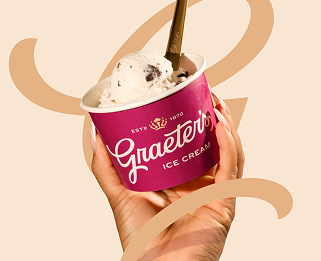
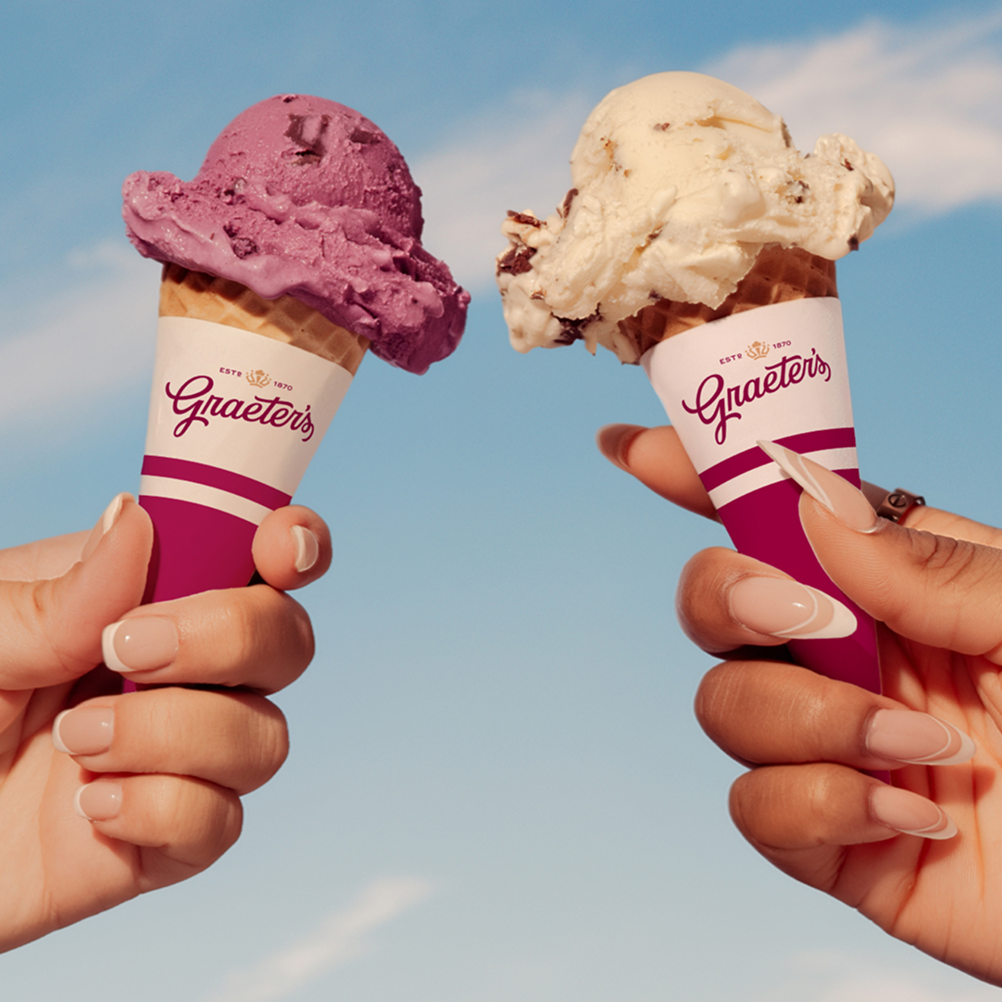
Bourbon Ball is thick and nutty, with chocolate chunks scattered unevenly through every scoop. Vanilla and pecan flavors come through quickly, while the bourbon itself shows up in the mid-palate and finish, leaning into spiced caramel with just a trace of oak. It's a flavor built to taste like Cincinnati and Northern Kentucky's shared whiskey history, not just a splash of liquor stirred into vanilla.
How to store bourbon ice cream once you bring it home
Graeter's says the small amount of alcohol in Bourbon Ball isn't enough to meaningfully change the ice cream's texture on its own.
Bourbon Ball is available year-round at Graeter's scoop shops, in select grocery stores, and for nationwide shipping through Graeters.com. If you've never tried it, a scoop shop visit is the easiest way to taste it fresh, with whiskey-glazed pecans and chocolate chunks straight from the French Pot.
FAQ
Does Graeter's bourbon ice cream actually contain alcohol?
Yes. Bourbon Ball contains real New Riff bourbon along with bourbon flavoring, but the finished ice cream comes in under 0.5% alcohol by volume, which is the legal threshold for a nonalcoholic product. That means anyone in the family can enjoy a scoop.
Where does Graeter's get the bourbon for Bourbon Ball ice cream?
Graeter's sources its bourbon from New Riff Distilling in Newport, Kentucky, just eight miles from Graeter's Cincinnati production facility. The two teams taste and select a single barrel together before it goes into production.
How much ice cream comes from one barrel of bourbon?
A single barrel yields 192 bottles of New Riff bourbon, and because the alcohol content in the finished ice cream is so low, one bottle can flavor roughly 120 gallons of Bourbon Ball. Even so, meeting demand across scoop shops and grocery stores takes an entire barrel at a time.
How can I keep bourbon ice cream from getting icy at home?
Try to finish a pint the same day you open it rather than letting it thaw and refreeze repeatedly. Every freeze-thaw cycle lets water molecules regroup into larger ice crystals, which dulls the dense, velvety texture Graeter's French Pot process is built to create.
Ready to taste it for yourself? Order a pint for home delivery or find a scoop shop near you.